It was back in February of 1848 that a German Philosopher named Karl Marx (1818 – 1883) published a political pamphlet, ‘The Communist Manifesto’. This text analyzed the shortcomings of the then-prevalent social system- capitalism. Economist Adam Smith’s idea of capitalism supported total private ownership, class distinction, profit-based production, and working according to market forces. However, with this approach, the working class suffered from low wages and social inequality. It created vast wealth for a few (the owners, or bourgeoisie) while leaving many in poverty and perpetuating class struggle for others (the working class, or proletariat).
During Industrialisation in 18th- and 19th-century Europe, numerous cases against the labour class were witnessed under unregulated capitalism. The conditions in factories were specifically harsh, with long working hours, low wages, hazardous machinery, accidents, and child labour. While the working people lived in overcrowded and unsanitary slums, capitalists lived a lifestyle backed by immense wealth. The rise in mortality rates, the formation of labour unions, worker protests, and revolutionary thoughts are just the aftermath.
Also Read: The Communist Manifesto by Karl Marx

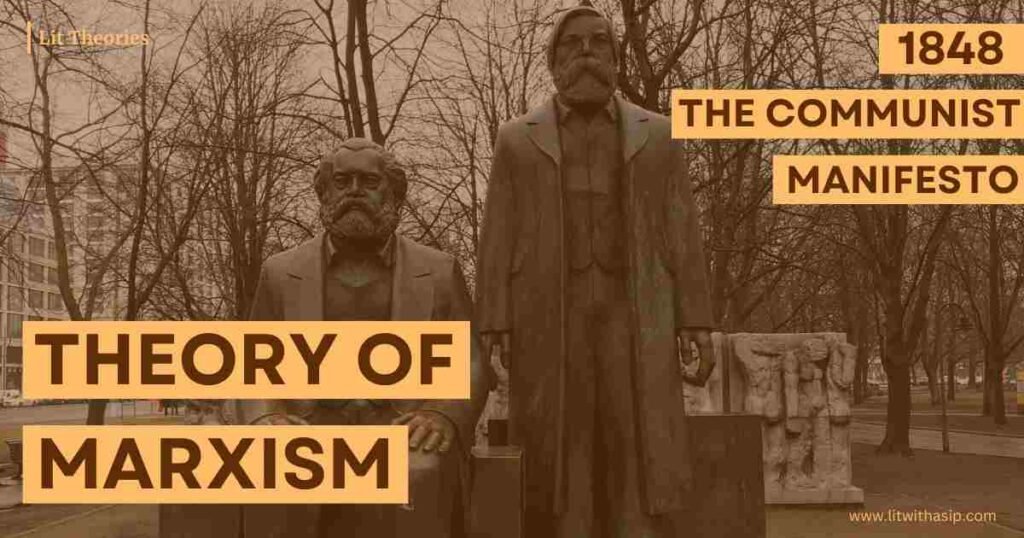
Today, it is important to understand Marxist theory because it has shaped economic thought, inspired social change, explained the nature of capitalism, and provided a framework for understanding globalisation. This article delves into Marxist theory and its key principles, so make sure you read it till the end:
Historical Background
Called the ‘Father of Communism’, Karl Marx had his own share of experiences and observations of the world around him as he was growing up. He was born in an era where the Industrial Revolution was at its peak, and so were the associated problems. Witnessing the widening gap between the working class and the owners, he felt an innate urge to bring about the social change that was the need of the hour. Plus, he belonged to a Jewish background, so it exposed him to prejudices and discrimination. He believed in creating, or at least laying the foundation for, a classless society that worked for the people rather than being driven solely by profit. He advocated collective ownership of the means of production instead of private ownership and sought to reduce economic inequality and class divisions.
Marx studied philosophy at the University of Berlin, which helped him to think from a different perspective. He also became a part of the Young Hegelians- a group wherein young minds came together to criticize the cultural as well as the political scenario of that time. Working as a journalist also helped Marx explore the unjust systems that prevailed in society and how to oppose them.
Marx’s closest collaborator and an essential figure in the development of Marxist theory was Friedrich Engels. It was in 1844, in Paris, France, that the two met at the Café de la Régence. Neither could have imagined that this meeting would mark the beginning of a lifelong friendship. While Marx often lived in poverty, Engels’ wealth, derived from his family’s business, allowed Marx to focus on his writing and research. In short, their partnership combined Engels’ practical experience and financial support with Marx’s intellectual and theoretical rigor.
Although Marx’s opinions and communist beliefs might seem a bit idealistic and utopian today, he knew they weren’t completely unachievable. He dreamt of an ideal society and formulated a work that could systematically define ways to achieve it, while also backing up every approach with reason at best.
Engels co-wrote ‘The Communist Manifesto’, which outlined the principles of communism. Both Marx’s and Engels’ thoughts aligned, especially concerning the exploitation of the working class. Engels wrote The Condition of the Working Class in England in 1845. In this book, he documented the dire living and working conditions of the English working class, providing real-world evidence that supported the development of Marxist theory.
In 1883, when Marx died of acute bronchitis, the stewardship of Marxist theory transferred to Engels. He made certain editions of it and called his version “scientific socialism”. However, these developments may not have been consistent with Marx’s original vision, as several historians and political theorists have argued.
Key Principles of Marxism
Please note that there isn’t a specific set of principles to Marxist theory. However, this article lists the ideas and approaches that the theory intends to present in as crisp and descriptive a manner as possible.
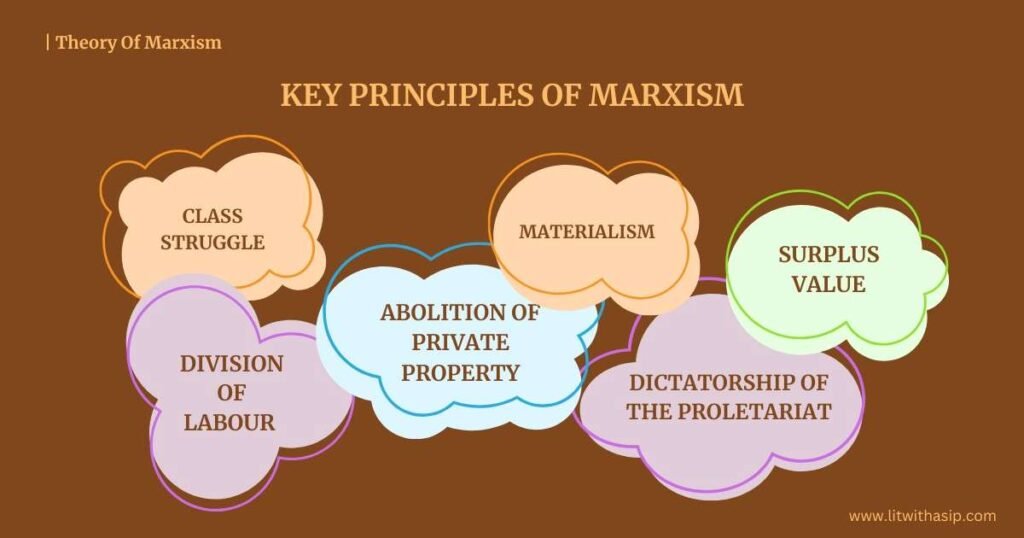
Class Struggle
Marxist ideas acknowledge the class struggle that has existed since the beginning of time. For instance, in ancient times, some masters and slaves lived in the same court but under different circumstances. In the Middle Ages, feudalism prevailed. It meant that one person would own the land, and others would work on it in return for protection and necessities of life, such as food and a place to live. Therefore, the bourgeoisie and proletariat were not new.
Also Read: Class Struggle: A Political and Philosophical History
Class determined one’s income and one’s identity in the broader society. While one set of society owns the grand resource or asset in question, the other set of people offer their services towards that asset (hence, the owner of the asset) to survive. This might seem like a codependent relationship and even justified until exploitation and unfairness enter the picture. Both extremes of society are struggling to reach a level; the bourgeoisie are seeking to maximise profits, and the proletariat are struggling to obtain fair wages, better working conditions, and equality. Moreover, profit-driven wages and wage gaps serve as ultimate proofs of economic exploitation.
The concept of false consciousness is also worth pointing out. Here, the working class is told that the visible gaps between the two major sets of society are fair because they are naturally occurring and unchangeable. This is not merely a notion blindly instilled, but also a reason why the root causes are even further disconnected. Marxism, with its revolutionary potential, created conditions of resistance and brought forth the idea of class consciousness– having the idea about one’s class in society.
Materialism
In Marxism, materialism is the basic philosophy that the economic base of society—its material conditions of production—determines its ideas, institutions, and history. This stands in opposition to idealism, which gives primacy to ideas over material reality.
Building on this foundation, Marxist theory identifies two key developments:
Historical Materialism as the application of materialism to history and society.
Dialectical Materialism as the method of materialism.
Although Marx and Engels did not explicitly use these terms in the Communist Manifesto, the principles behind them are central to understanding Marxism. Both revolve around the role of contradictions in shaping society. Let us expand on them further:
Historical Materialism shows how history develops through conflicts between different social classes. It argues that history is not driven by abstract ideas or morality alone, but by material/economic conditions and the struggles these create. For instance, the famous line from the Manifesto states: ‘The history of all hitherto existing society is the history of class struggles.’ These struggles—slave vs. master, serf vs. lord, worker vs. capitalist—explain how societies transform and why new systems (like socialism) emerge out of capitalism.
Dialectical Materialism is the underlying method: the logic that contradictions drive all change. It shows that progress occurs through the clash of opposing forces or ideas, leading to a new outcome. In the Manifesto, this is expressed through examples, such as ‘Freeman and slave, patrician and plebeian, lord and serf, guild-master and journeyman’—each pair locked in opposition, pushing society forward.
In short: historical materialism applies dialectical materialism to history—the method explains the process, while the history shows the outcome.
Surplus Value
We know that the capitalist society is driven by ‘profit’. But where is that ‘profit’ coming from? Marxist ideas denote that this profit is nothing but the difference between the work expected out of labour or the work they do and the wages they get paid for it. Usually, the wages are less than the work done by the labourer, hence leading to what we can call ‘unpaid labour’. This is how the ‘profit’ comes into place for the owners or the bourgeoisie.
The capitalist appropriation stems from the fact that the capitalist owns the means of production. Labour, to earn wages, gives energy in the form of working hours, where the working class usually delivers more than the cost of the wages. Given these conditions, Karl Marx also presented a ‘Labor Theory of Value‘, stating that the value of commodity should be calculated based on how much time it takes for the labourer to produce it.
All in all, the theory of surplus value is pivotal to Marx’s ideas of capitalism and how it leads to labour exploitation. This is because Marx posited that labourers are working more than they receive.
Division Of Labour
In the concept of the division of labour, we see how Marx’s views differ from those of Adam Smith. Marx says that in a capitalist setup, division of labour leads to labour alienation, social fragmentation, worker disempowerment, class division, and conflict. At the same time, the motive behind this kind of division seems to be rooted in driving out more profit and specializing and segregating the labor force to yield benefit of the bourgeoisie.
Abolition of Private Property
The abolition of Private Property is the central demand of Communism. In Marxist terms, “private property” does not refer to personal belongings (like a toothbrush, clothes, or a house). Instead, it specifically refers to bourgeois property—the private ownership of the means of production (such as factories, large-scale land, machinery, and raw materials).
Marx argued that private ownership leads to capitalism and resulting exploitation and class struggle. It helps capitalists extract surplus value, which appears as profit, from the labor of the working class, while leaving workers alienated from the products of their own labor.
The goal of abolition is to end this exploitative relationship by converting the means of production from private ownership to social or common property, that is collectively owned and democratically controlled by society. This is not only revolutionary but foundational to achieving a classless society.
Dictatorship of the Proletariat
Marx viewed all societies in history as products of the “dictatorship” of one class over another. The Dictatorship of the Proletariat means that the roles are reversed between the bourgeoisie and the proletariat. In this sense, the working class takes over and runs the state, thus becoming the new ruling class. A revolution like this would flip the control, making the majority of working people the ones with all the political and economic power. They would use that power to manage society and eliminate the old system. Thus, a stateless and classless society would come up, and all work would be valued equally.
Conclusion
Marxism has found various applications in history, literature, and social work. Marxism enabled social change based on economic factors, acknowledged class struggle, and made us understand how class distinctions limit individual growth and behavior. Countries like China, North Korea, Laos, Cuba, and Vietnam are communist today.
Marxist views have also been heavily criticised for focusing too much on class, dogmatism, and a lack of internal coherence. In fact, Karl Marx has been recognised as one of the most loved as well as the most hated people for the kind of notions he proposed in some centuries. It is also called an idea of a society where everything is so equal that competition and the possibility of further growth end. Utopian enough, the theory continues to be criticised to date.


Jennis Jacob, a passionate literary enthusiast in her 20s, is a writer and poet. With eight years of experience in literature, she is currently a master in English and finds inspiration in Womanist, American, and Indian Partition Literatures. Her works have appeared in anthologies such as ‘Carved Words Of Creative Minds’ and ‘100 Splendid Voices,’ and she is working on upcoming books. Through LitWithASip, she aims to ignite a love for literature and empower individuals to embrace their true selves.